
The Prop Game
The facilitator assembles a group of common household items (e.g., a pen, a paper clip, a fork) to be used as props. Player 1 selects an item and writes down five things that they will transform the prop into, showing their list to no one by placing it face down.
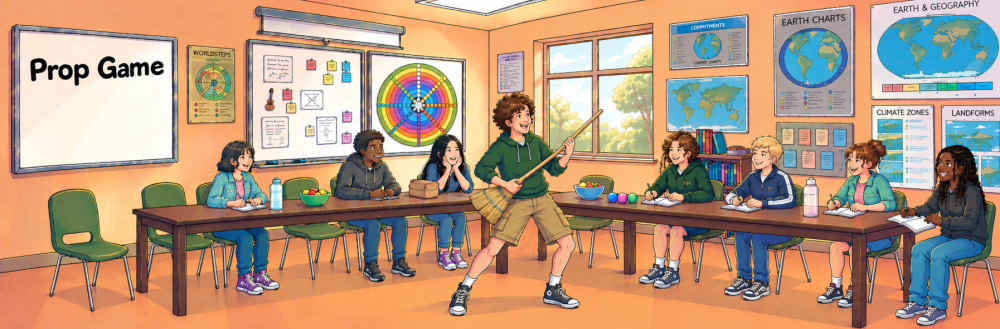
Player 1 then uses the item, non-verbally, pantomiming in a way that transforms the item into one of the items on their list.
The Roles
The Performer is the Player who is pantomiming.
The Audience is made up of other Players. They make guesses about what the Performer has transformed their prop into.
The Facilitator keeps time, records scores, and resolves any disputes. This role rotates among the Players, providing a chance for Players to learn leadership skills.
Important—The Roles rotate after each turn.
Note: In some situations a teacher or other adult may need to start off as the permanent Facilitator. In this scenario, only the Performer role and Audience role would rotate. As the Players become more skilled, they should take on the Facilitator role.
Preparation
Materials: Each Player assembles a group of common household items, or anything on hand (e.g., pen, paper clip, fork, rock, stick, etc.), to be used as props. Recommended: 10+ objects per Player.
Lists: At the beginning of each Round, all the Players choose one of their items and they write down five things that they will transform that prop into by pantomime (no talking). They don’t show their list to anyone. Each Player has one minute to make their list.
Note: The prop must be transformed into something other than what it is (e.g., a scissor cannot be used as a scissor, but could be transformed into a telephone).
Gameplay
At the beginning of their turn, the Performer shows their list of five items to the Facilitator only. They pick their prop, and, through pantomiming, transform it into one of the things on their list. An example might be moving a pen across your mouth like a toothbrush.
Members of the Audience call out their guesses as to what the Performer has changed their object into.
When the object is guessed correctly, the Facilitator calls out, “Next!” as a signal for the Performer to go to the next item on their list. If the Performer is not having any luck, the Performer can call out “Next!” to signal the Facilitator that they are going to the next item on their list, using the same prop. In this case they don't get the two points for the skipped pantomime. This continues for one minute or until all five list items are guessed.
After the Performer completes their turn, the Facilitator double checks the Performer’s score and records how the Performer wants to distribute their points (more about point assignments in "Scoring Strategy" section below).
The Performer then becomes part of the Audience, and another Player takes their turn as the Performer.
Scoring the Prop Game
Two points are awarded to the Performer for each correct guess from an Audience member. Players can earn a maximum of 10 points per turn.
Definition of Terms
Turn: The Performer's one-minute pantomiming of their list
Round: A Round is completed when each Player in the game has performed.
Timing
One minute to make lists at the beginning of each round.
One minute to pantomime all objects on the list
Prop Game Scoring Guide
Three Players: To unlock the inner starburst circle, all Players must arrive just outside of the circle within 27 turns, and must collectively have 48 Community Points.
Four Players: To unlock the inner starburst circle, all Players must arrive just outside of the circle within 36 turns, and must collectively have 64 Community Points.
Five Players: To unlock the inner starburst circle, all Players must arrive just outside of the circle within 45 turns, and must collectively have 80 Community Points.
Six Players: To unlock the inner starburst circle, all Players must arrive just outside of the circle within 54 turns, and must collectively have 96 Community Points.
Seven Players: To unlock the inner starburst circle, all Players must arrive just outside of the circle within 63 turns, and must collectively have 112 Community Points.
Eight Players: To unlock the inner starburst circle, all Players must arrive just outside of the circle within 72 turns, and must collectively have 128 Community Points.
Modifications Encouraged
To adapt the game for different ages and skill levels you may alter the game. The number of turns and Community Points needed determines the difficulty of the game. The recommended turns and Community Points are challenging, but doable for an average group. To make the game more difficult, decrease the number of turns and shorten the time limits and increase the number of Community Points needed. You can also raise the number of Points to Advance to make it more difficult to get to the next circle. To make it easier, do the opposite of the above.
Note to teachers and educators: Playing this game helps students to develop many academic skills, including social-emotional development, English language development, and mathematics. Included below are links to the California Department of Education website.
California Department of Education Language Arts goals: https://www.cde.ca.gov/be/st/ss/documents/englangdevstnd.pdf
California Department of Education Mathematics goals: https://www.cde.ca.gov/ci/ma/cf/
Scoring Strategy
To win the game every Player must get to the inner starburst circle within the designated number of turns and also all the Players must collectively donate enough points to the Community Points Total. In order to achieve this, there are four categories into which Players can distribute their points. These categories are labeled on the Scoring Sheet. They are, Saved Points, Points to Advance, Donated Points, and Community Points.
Saved Points: If a Player fails to get the 6 points needed to advance in their first turn as a Performer, they stay in the circle where they are and try again on their next turn. They can save the points they earned on their first turn and can add them to the points they earn in their next turn as a Performer in order to meet the 6-point requirement to advance to the next circle. If one Player donates points to another Player, they are added to the receiving Player’s Saved Points.
Points to Advance: In order to advance to the next inner circle, players need to deposit 6 points in the Points To Advance box on the score sheet.
Donated Points: Players who earn more than 6 points on their turn may donate points to other Players that may be falling behind. This is done, if needed, in order to help everyone get to the inner starburst circle within the designated number of turns. Donated Points are added to the Saved Points of the Player who receives them. When a Player receives donated points, they can add them to their Saved Points category. If the total adds up to 6 points or above, they can immediately move to the next inner circle. This does not count as another turn.
Community Points: Players who earn more than 6 points on their turn may donate points to the Community Points category. The entire group of players needs to collectively donate a certain number of points to the Community Points category to win the game.
Note: If a Player earns 8 points or more on their turn, they have the option of donating some points to another Player and some to the Community Points category.
- Hits: 62